1
Command
A visible standard helped people locate leadership and direction in confusion.
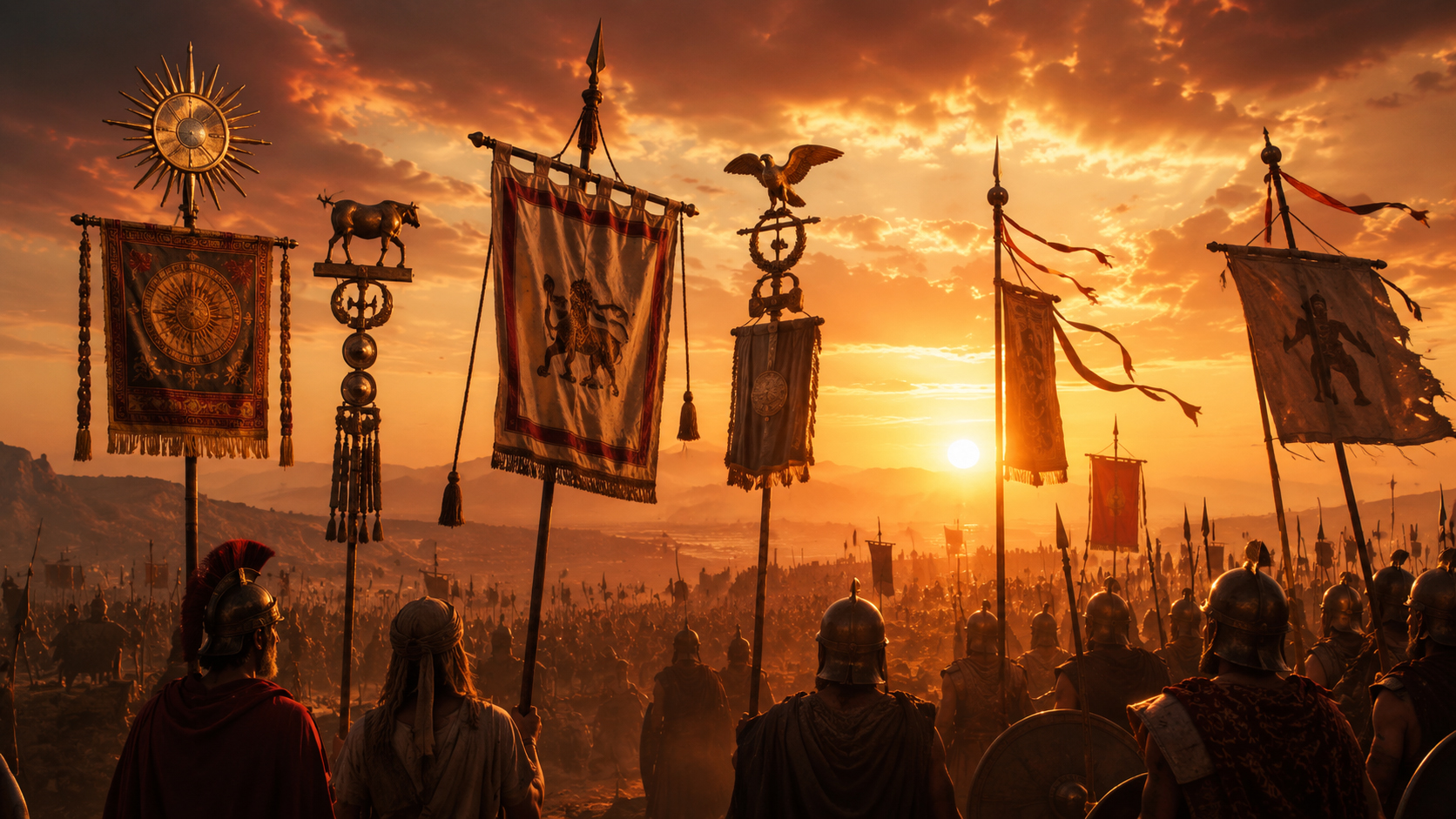
Ancient standards were the ancestors of flags: raised symbols carried into battle, ceremony, procession, and public life. They helped people see command, identity, courage, faith, and belonging from far away.
The first public symbols
In the ancient world, a raised symbol could organize people faster than a shouted command. On a battlefield, in a procession, or before a crowd, standards told people where to look, where to gather, whom to follow, and what power was present.
These early symbols were not always cloth. Some were metal, carved wood, animal figures, sacred emblems, staffs, poles, streamers, or combinations of materials. The shared idea was visibility: lift the symbol high enough and it becomes public language.
Why standards mattered
Ancient standards carried practical and emotional weight. They helped soldiers keep formation, gave commanders a visible point of control, and gave ordinary people a symbol around which to rally.
A visible standard helped people locate leadership and direction in confusion.
The symbol showed which army, ruler, tribe, city, or sacred authority was present.
In movement or battle, standards helped groups stay oriented and organized.
A raised symbol could steady people under pressure and give them something to defend.
Standards appeared in parades, rituals, triumphs, and public displays of power.
Over time, a standard could become a story: victory, loss, loyalty, or sacred duty.
From object to emblem
Ancient standards compressed authority into a form people could recognize instantly. A bird, a beast, a sun, a sacred object, a color, a crest, or a staff could stand for a ruler, a god, a military unit, a city, or a people.
Modern flags inherit that same magic. A national flag is not powerful because cloth is powerful. It is powerful because a community agrees that the symbol carries memory, dignity, identity, and meaning.

A short historical path
The line from ancient standards to modern flags is long and uneven, but the core idea stayed remarkably stable: lift a symbol high enough, make it recognizable, and people can organize around it.
Totems, emblems, sacred objects, and visible signs helped groups distinguish themselves.
Raised standards became practical tools for orientation, order, command, and morale.
Military units and states developed recognizable emblems with ceremonial and political meaning.
Cloth banners, shields, colors, and heraldic devices turned identity into a rich visual system.
Flags became the shared symbols of nations, revolutions, civic institutions, and public memory.
SolarFlag.com
That ancient purpose still matters. A flag is a public symbol — and at night, lighting helps it remain visible, dignified, and alive.